Solar for poultry farms: broiler houses, layers and backup power

Tony Lopes
Short answer: Solar suits poultry farms because ventilation and lighting are electric and peak on hot, sunny days, and broiler houses have long roofs. But birds can die quickly when fans stop, so the backup design matters more than the number of panels. Brooding heat is usually gas or coal, so solar cuts the electricity bill rather than the heating bill.
Last updated November 2026.
Modern broiler and layer houses are fully environmentally controlled: fans, cooling pads, lighting programmes, feed and water lines all run from a controller. The South African Poultry Association has described houses costing up to R5 million each, and pointed out that when the power fails, ventilation stops. That is why almost every commercial farm already has a generator, and why many are now looking at solar and batteries to cut both the Eskom bill and the diesel bill. This guide covers where solar fits on a poultry farm, how to keep birds safe during outages, and what to plan for.
Where does a poultry farm use electricity?
| Load | Fit with solar | Notes |
|---|---|---|
| Tunnel ventilation fans | Very good | The biggest electrical load in most broiler houses, and it peaks on hot afternoons when panels produce most. |
| Evaporative cooling pumps | Very good | Runs in the heat of the day alongside the fans. |
| Lighting programmes | Partial | Much of the lighting runs early, late or at night. LED lighting cuts this load sharply. |
| Feed and water lines | Good | Augers and pumps run through the day. |
| Brooding heat | Poor | Usually gas, coal or diesel heaters, and needed most on cold nights. Solar PV does not replace this unless heating is electric. |
| Egg collection, grading and cold storage | Good | Layer farms run these through the working day; cold stores need power at night too. |
| Abattoirs and processing | Good in daylight | Far bigger consumers than the houses themselves, with heavy refrigeration loads. |
For cold stores and processing, see our guide to solar for cold rooms, packhouses and dairies.
Why is backup power the most important part of the design?
In hot weather, birds in a closed house can suffer heat stress very quickly once the fans stop. A generator that takes a minute to start, or fails to start, can cost a whole house. A solar system for a poultry farm should be designed around continuity first and savings second:
- Battery-backed supply for controllers, alarms and fans, so the switch from grid to backup happens without the controller resetting.
- An automatic generator start when batteries run low, with the generator sized to carry the critical loads on its own.
- Alarms that reach a person, by phone or SMS, when power, temperature or the generator fails.
- Regular full-load tests of the changeover, not just the generator idling on its own.
A hybrid system with batteries usually gives a faster, cleaner changeover than a generator alone, and it lets the generator run far fewer hours.
Can panels go on the house roofs?
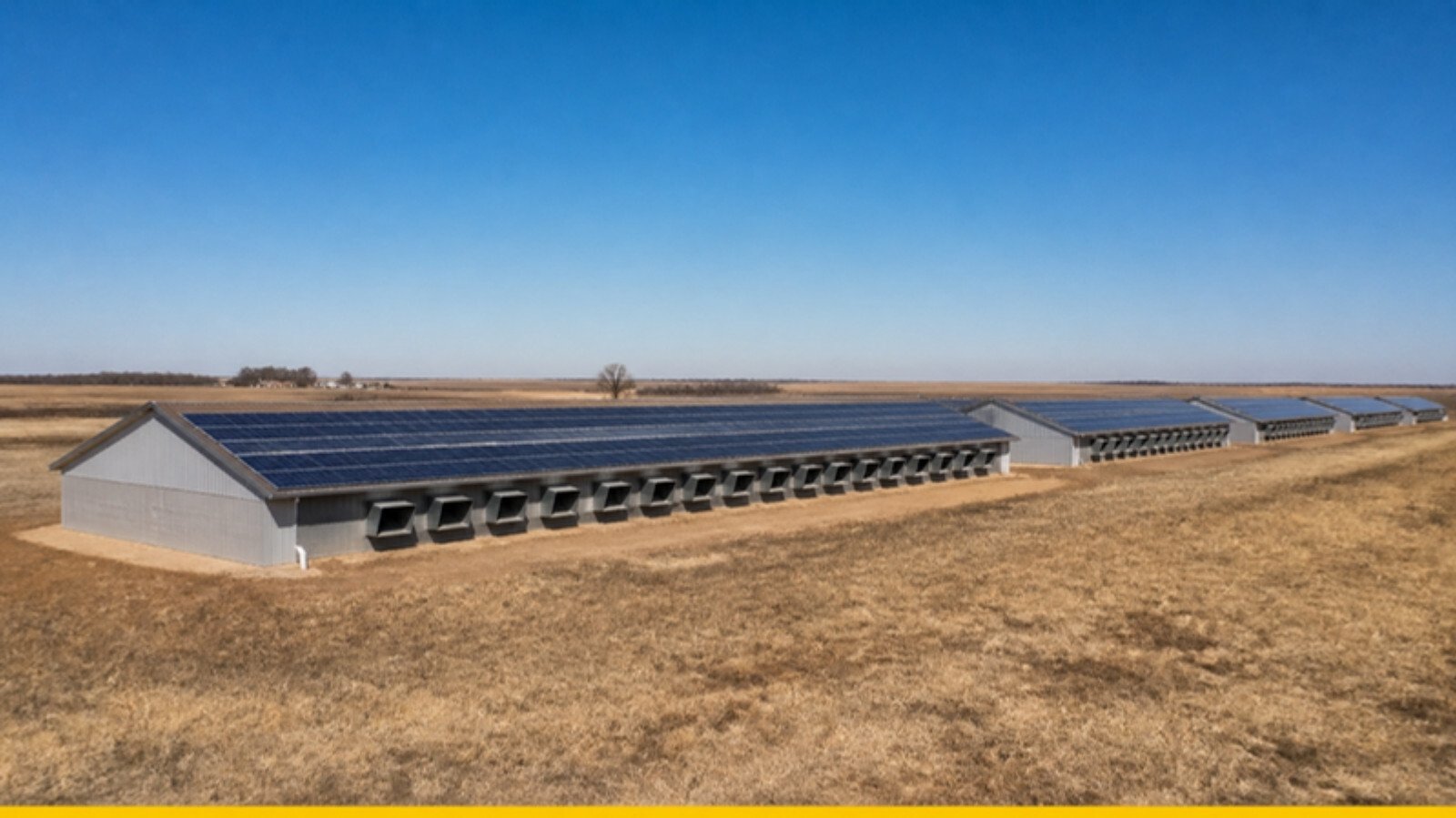
Often, yes. Long broiler and layer house roofs face in a consistent direction and have plenty of space. Before committing, an installer should check:
- Roof structure and condition: older houses may not carry the extra weight, and roof sheeting near the end of its life should be replaced first.
- Corrosion: ammonia and dust from inside the house can attack fixings and cables, so material choice matters.
- Dust on panels: extraction fans push dust onto nearby panels. Plan for cleaning, or place arrays upwind or on the ground.
- Access and biosecurity: installation and cleaning crews must follow your biosecurity rules, and work is best scheduled between cycles when houses are empty.
What does solar look like on South African poultry farms?
Systems range widely. A poultry farm at Mookgophong in Limpopo has run a 749 kWp grid-tied solar system since 2020. At the other end of the scale, Tahila Broilers near Rustenburg, built to produce up to 700,000 broilers per cycle, runs on a fully off-grid solar, battery and inverter system. Most farms start with a hybrid system on one or two sites, sized to the daytime ventilation load, with batteries for the critical loads.
Does the same apply to piggeries and other intensive livestock?
Largely. Piggeries also depend on ventilation, and farrowing houses add heat lamps or heat pads for piglets, which run through the night. Feed mills on the same farm are good daytime loads for solar. As with poultry, the backup design comes first.
What will it cost and how is it paid for?
It depends on the number of houses, the fan load and how much battery backup you need. A farm run as a business can usually deduct the full cost of a solar PV system of up to 1 MW in the year it is brought into use, under Section 12B. See our guide to the Section 12B solar tax deduction, and our commercial solar payback examples. Many farms are on Eskom rural tariffs; see Ruraflex and Landrate.
What should I gather before getting quotes?
- Twelve months of electricity bills, with the tariff name.
- Generator records: fuel used per month and running hours.
- House details: number of houses, number and size of fans, cooling pads and lighting type.
- Your production calendar: placement and clean-out dates for each house.
- How you heat: gas, coal, diesel or electric, and how much you use.
- Roof details and photos, or space for ground-mounted panels.
Safety First
- Never let a solar project weaken your backup. Test the changeover under full load before the next placement.
- The installation must be done by a registered installer who issues a Certificate of Compliance, and grid-connected systems must be approved by Eskom or the municipality.
Frequently Asked Questions
Can solar run tunnel ventilation without batteries?
In daylight it can supply most of the load, but without batteries there is no protection when clouds roll in or the grid fails. For bird safety, the critical loads should always have battery or generator backup.
Will solar heat my brooding houses?
Not directly. Most brooding heat comes from gas, coal or diesel. Solar lowers the electricity bill; heat pumps or better insulation are the usual routes to cutting heating costs.
How big a system does a poultry farm need?
It depends on the fan load, the number of houses and how much backup you want. Start from your bills, generator records and house details rather than a standard package.
Where We Fit In
CleanVolts matches poultry and livestock farms with registered CleanVolts Approved installers who handle agricultural and commercial systems. The installer contracts with you directly. Using CleanVolts costs you nothing, and if the installer pays us a referral fee, we tell you up front.
Sources: Poultry World via UkrAgroConsult on outages in the poultry sector; Rhino Energy on the Mookgophong poultry farm; Sunbird LED on Tahila Broilers.