Solar borehole and irrigation pumps: costs and sizing

Tony Lopes
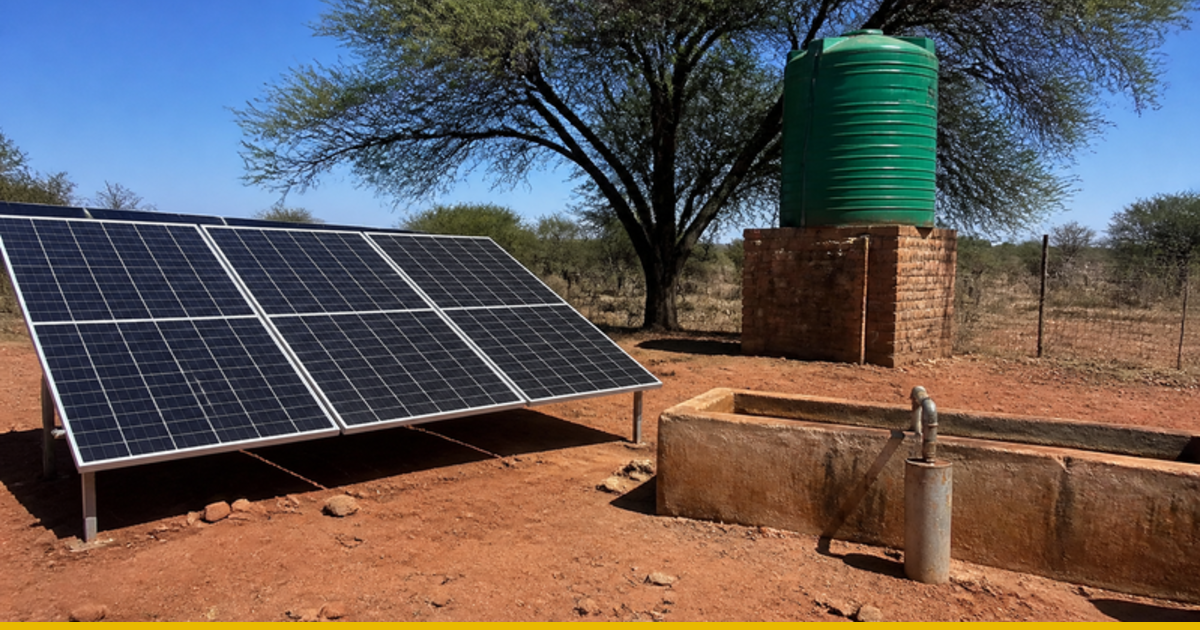
Short answer: Size a solar pump from two numbers: how much water you need a day, and the total head, which is the depth to water plus the lift to the tank plus pipe losses. Choose a pump that delivers that volume in about five hours of good sun, and fit roughly 1.3 to 1.5 times the pump's kW in panels. Store water in a tank, not power in a battery. Against diesel, most systems pay back in two to five years.
Last updated November 2026. Prices checked November 2026.
Pumping water is one of the jobs solar does best on a farm. A pump only needs to run while the sun is up, the water can wait in a tank until it's needed, and the alternative is usually a diesel engine or an Eskom connection that costs more every year. Diesel inland went from about R19 to almost R32 a litre in the year to October 2026. This guide explains how to size a solar borehole or irrigation pump, what it costs, and the mistakes that leave farmers with a dry tank. It's part of our wider guide to solar for farms.
How do you size and cost a solar borehole or irrigation pump?
- Work out the water you need per day. Add up livestock, household, dairy and irrigation use. As a guide, a cow drinks 40 to 100 litres a day in summer, a sheep 5 to 10 litres, and a household 150 to 250 litres per person.
- Know your borehole. You need the yield test result (how many litres an hour it can safely give), the water level, and the depth the pump will hang at. Never plan to pump more than the tested yield.
- Work out the total head. Add the depth to the water level while pumping, the height from the borehole to the top of the tank, and pipe friction losses, which a pump supplier works out from the pipe length and diameter.
- Pick a pump that delivers the daily volume in about five hours. Size for winter sun, not summer. The pump's curve shows how much it delivers at your head.
- Fit panels at 1.3 to 1.5 times the pump's rating. A 1.5 kW pump usually gets about 2 to 2.2 kW of panels, so it starts early and keeps running on hazy days.
- Size the tank for at least two days of water. That carries you through a cloudy spell without a battery.
What does a worked example look like?
A cattle farm needs about 15,000 litres a day for 120 head and the farmhouse. The borehole's tested yield is 4,000 litres an hour.
| Step | Working | Result |
|---|---|---|
| Total head | 60 m to water + 5 m tank stand + about 5 m pipe losses | 70 m |
| Flow needed | 15,000 litres in 5 winter sun hours | 3,000 litres an hour (within the borehole's yield) |
| Pump | Supplier's pump curve at 70 m and 3 m³ an hour | About 1.5 kW |
| Panels | 1.5 kW × 1.4 | About 2.2 kW, or four 550 W panels |
| Storage | Two days of water | 30,000 litres of tanks or a reservoir |
In summer the same system pumps more than 15,000 litres on a clear day, which is useful for topping up a reservoir. The pump supplier should confirm the selection against the manufacturer's curve before you buy.
What does a solar borehole pump cost?
Installed prices depend mostly on depth and daily volume. These ranges are from a South African price guide updated in July 2026 and include VAT:
| System | Depth to water | Water a day | Pump and panels | Installed price |
|---|---|---|---|---|
| Shallow, household | 10 to 40 m | 1,000 to 3,000 L | 0.37 to 0.75 kW, 3 to 4 panels | R25,000 to R45,000 |
| Mid-depth | 40 to 80 m | 3,000 to 8,000 L | 0.75 to 1.5 kW, 6 to 8 panels | R45,000 to R80,000 |
| Deep or high-flow | 80 to 150 m | 8,000 to 20,000 L | 2.2 to 4 kW, 10 to 16 panels | R80,000 to R120,000 |
| Farm and irrigation | 150 m or more, or big volumes | Over 20,000 L | 4 to 11 kW, 16 to 40+ panels | From R120,000 |
Tanks, the tank stand, trenching, pipework and a lockable cage for the panels are often quoted separately, so check what's included.
How does solar compare with diesel and Eskom over five years?
| Solar pump | Diesel pump | Eskom-fed pump | |
|---|---|---|---|
| Upfront cost | Highest | Lowest | Low if a line is close, very high if not |
| Running cost | Close to nil | Often R2,000 to R6,000+ a month in fuel | Monthly bill plus fixed charges, rising each April |
| Five-year cost (example) | About R80,000 once, plus servicing | R4,000 a month in fuel = R240,000, plus engine services | Depends on tariff and connection |
| Pumps at night | No, unless you add a battery | Yes | Yes |
| Theft risk | Panels, so they need securing | Fuel and engine | Cable |
The farm in the example spends R4,000 a month on diesel. A R80,000 solar system pays that back in about 20 months, and every month after is fuel not bought. Solar submersible pumps typically last 8 to 15 years and the panels carry 25-year warranties. If you also run the farmhouse, sheds or cold rooms on Eskom, our guide to solar for farms covers those loads.
Is a tank better than a battery?
For most farms, yes. Storing water is far cheaper than storing electricity.
| Tank or reservoir | Battery | |
|---|---|---|
| Cost to cover two days | Usually a fraction of a battery's cost | High, plus a battery inverter |
| Lifespan | Decades for a good tank or concrete reservoir | About 10 years for lithium |
| Gives pressure by gravity | Yes, from a raised stand or a high point | No, you still need a pump to deliver |
| When it's the right choice | Livestock, household and most irrigation | Night irrigation, or where water must be pumped on demand |
What goes wrong with solar pumps?
- Pumping more than the borehole can give. Overpumping draws the water level down, can damage the pump and can ruin the borehole. Fit dry-run protection and size to the yield test.
- Sizing for summer. A pump that just meets demand in December falls short in June.
- Guessing the head. Underestimating pipe losses on a long run to a far tank is common. Ask the supplier to calculate it.
- Unsecured panels. Remote arrays are a target. Budget for anti-theft bolts, a cage or a mounting on a raised steel structure.
- Mixing up irrigation volumes and water rights. Larger irrigation abstraction may need to be registered or licensed with the Department of Water and Sanitation. Check before you size a big irrigation pump.
Safety First
- Panels make DC power whenever there's daylight. Many solar pump controllers run at several hundred volts DC. Only a qualified person should open the controller or the junction boxes.
- Earth the array and the controller properly. Remote farm installations are exposed to lightning.
- Use a registered electrician where the system connects to any other supply, such as Eskom or a generator, and keep the Certificate of Compliance.
Frequently Asked Questions
Can solar pump water at night?
Not directly. A solar pump runs while the sun is up and fills a tank, which supplies water day and night. If you must pump at night, you need a battery or a hybrid setup with Eskom or a generator, which costs a lot more.
Do I need batteries for a borehole pump?
Usually not. A tank holding two days of water does the same job for far less money and lasts much longer. Batteries make sense only where water must be pumped on demand or at night.
How deep can a solar pump lift water?
Solar submersible pumps are made for heads of well over 200 metres, though the deeper the water, the bigger the pump and the more panels you need for the same volume. The manufacturer's pump curve shows what a specific pump delivers at your head.
Where We Fit In
CleanVolts matches farms with vetted, registered CleanVolts Approved installers. Send us your diesel or electricity costs and your borehole details, and we'll put you in touch with an installer who can size the pump, panels and storage from your yield test and water needs. You contract the installer directly. Using CleanVolts costs you nothing, and if the installer pays us a referral fee, we tell you up front.
Sources: EnergyBee, solar borehole pumps in South Africa, updated July 2026; BusinessTech on October 2026 fuel prices; Department of Water and Sanitation.